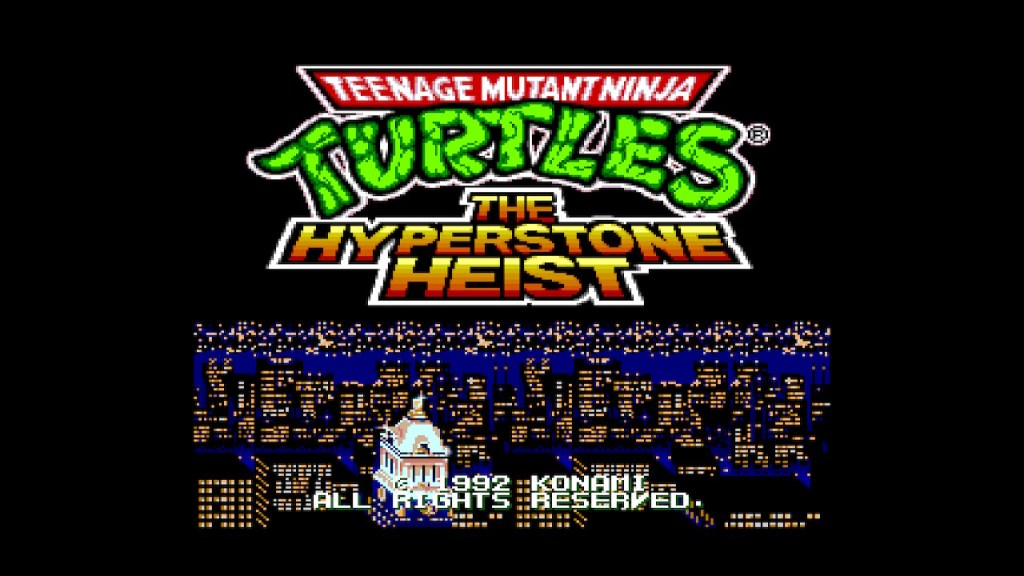
Recently, my cousin and I revisited Teenage Mutant Ninja Turtles: The Hyperstone Heist. Like many, the TMNT brand was a childhood staple for us. I myself grew up with both Hyperstone Heist and its SNES counterpart Turtles In Time, but I wouldn’t experience the arcade game that inspired both titles until its inclusion with Teenage Mutant Ninja Turtles 3: Mutant Nightmare in 2005.
| Sega Genesis | PlayStation 5 | PlayStation 4 | Xbox Series X/S | Xbox One | Nintendo Switch | PC |
| Reviewed On: Nintendo Switch |
For most, the arcade release serves as what is considered to be the greatest game to feature the heroes in a half-shell, which is a sentiment I shared until now. Thanks to the Cowabunga Collection my cousin and I played through Hyperstone Stone Heist and the arcade version of Turtles In Time back to back via online multiplayer. Surprisingly, I found myself enjoying playing the former more than the latter, and I figured the explanation for this would also serve well as a review.
Video provided by YouTube user Retro Tony
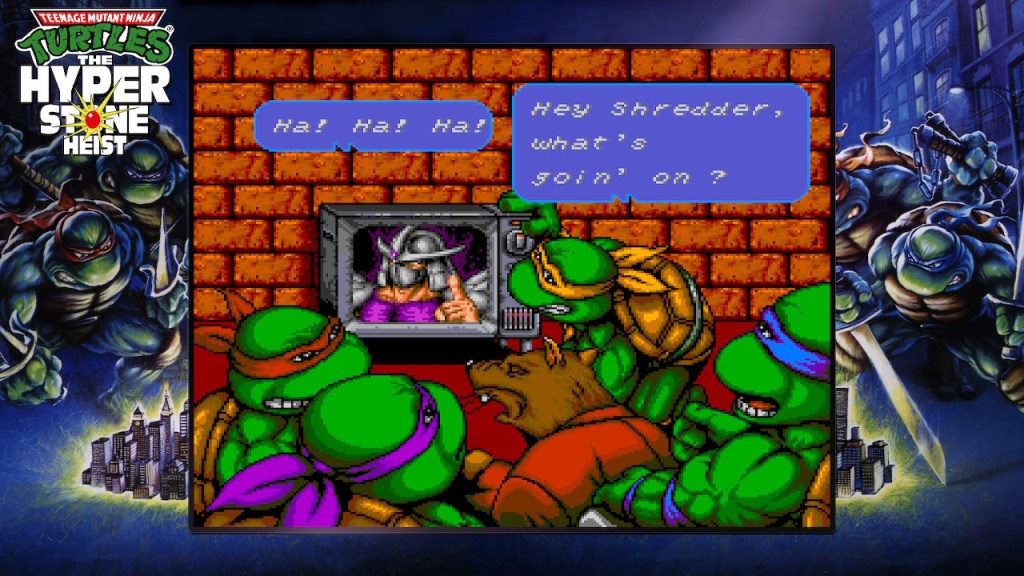
I’ll open up by stating that Hyperstone Heist won’t appeal to those looking for a heavy narrative. Both stereotypical and cliche, the story boils down to Shredder attempting to conquer the world…again. However, I think it’s safe to say that those interested weren’t lured in by the plot. Action is a key ingredient to any beat ’em up and Konami was very generous.
From the jump, you’re given the option to choose from any of the four turtles, and while the game doesn’t say so specifically, there are differences to how each one plays. Being the face of the quartet, Leonardo is the most balanced, having solid speed, power, and attack range. Michelangelo has the slowest attack speed, but deals noticeably higher damage compared to his brothers, taking down enemies in fewer hits. Donatello has the Longest reach due to his bo-staff but has a painfully slow walk speed making spacing vital. Lastly, Raphael is the opposite of Donnie, having the fastest walking speed, but the shortest attack range due to the length of his sais.
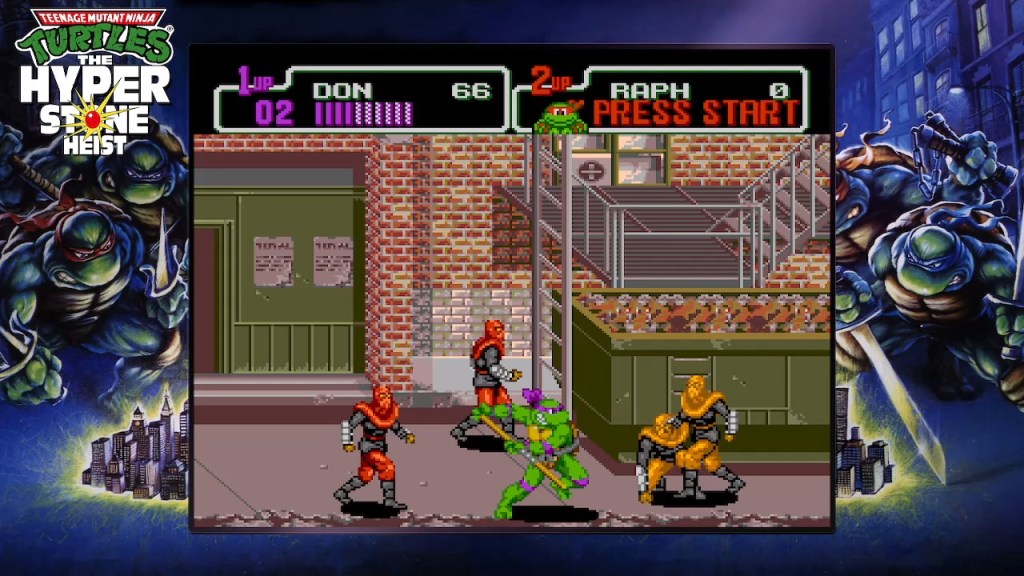
Controlling the heroes is executed by a combination of the dpad and three buttons. One button is designated for attacks, the other is assigned for jumping, and the last is for sprinting. Battle itself is simplistic especially when compared to modern titles like Shredder’s Revenge. While combo potential is low, the combat system does have its nuances with certain techniques being better suited for certain situations. Regardless, the gameplay still holds up and while it’s limited, the precision and tightness have aged well.
Some design aspects of Hyperstone Heist are undoubtedly, inferior to the arcade game that inspired it. For starters, the game only allows for two-player team-ups as opposed to four, and the game’s visuals pale in comparison. This also applies to how the game performs as well, with Turtles In Time being noticeably smoother and more fluid on arcade hardware. Even the audio is a detectable downgrade from Turtles In Time, which has clearer sound and better voice-overs.
Lengthwise, the game is shorter, with a count of five stages in total. There is an exclusive boss in the form of Tatsu, who originated from the 1990 live-action film and though he’s a nice addition, his inclusion still isn’t enough to help Hyperstone Heist stack up against its predecessor as far as content. As a result, fans looking to experience more characters and landmarks from the franchise are better off playing Turtles In Time.
Despite not being on a similar technical level, I feel that Hyperstone Heist is better designed as a whole due to its console roots. Arcade games might look the part, but I often find them more frustrating than their less powerful counterparts. Their specs might be impressive, but they’re quarter-munchers when it’s all said and done.
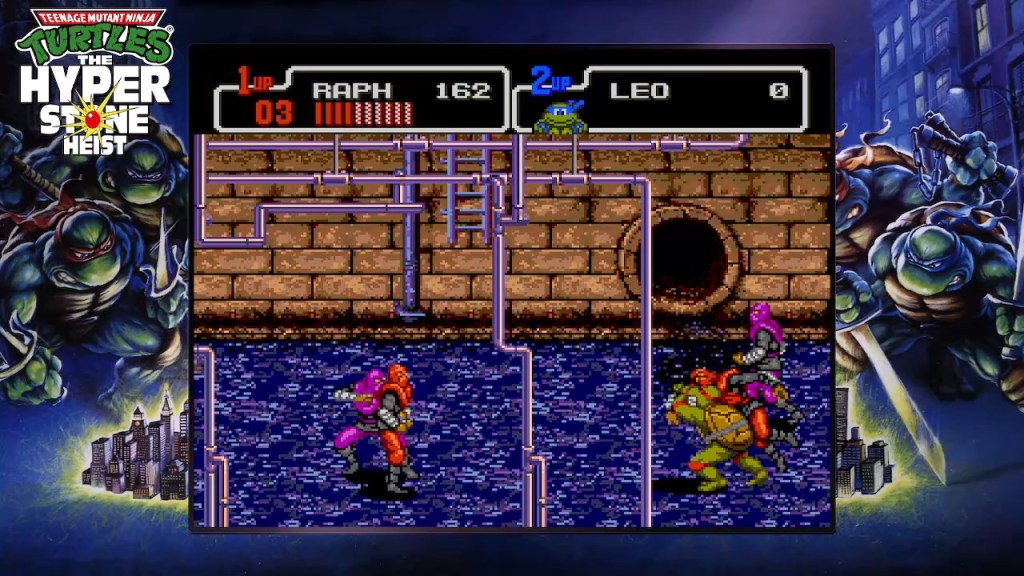
They can be annoying, even downright unfair at times and whenever they’re ported over to consoles, developers counter this by simply giving players an unlimited amount of coins. This makes a game much easier, but also eliminates the challenge, turning the outing into a cycle of fight, die, and insert another quarter. Since Hyperstone Heist is designed specifically for the Genesis, the difficulty strikes a much better balance, allowing for it to shine above the arcade version.
By default you’ll start off with three lives and three continues. Having a set amount might seem limiting, but it brings a challenge, adding stakes and a sense of urgency to combat. The enemy A.I has also been adjusted, and while they still apply pressure offensively, they don’t completely swarm players like Turtles in Time.
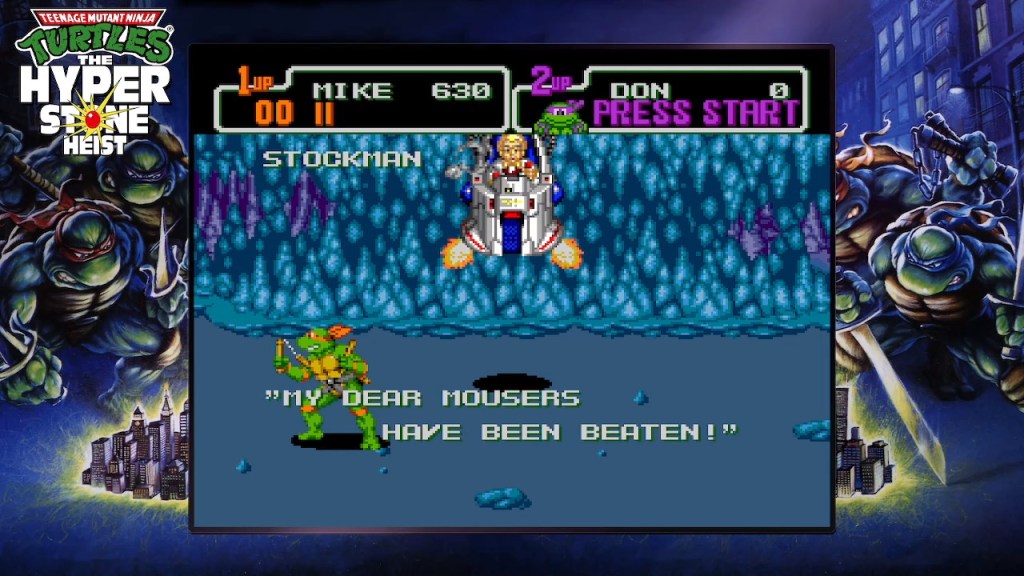
If the difficulty still seems too hard or easy, players can adjust it within the game’s options menu. Here you can choose a between three difficulty levels, as well as increase or decrease the maximum of lives you receive. There’s also a neat little feature that lets change the look of the turtles, letting you change their color scheme to how they appeared in the comics, or the hit 80’s cartoon.
The Arcade version of Turtles in Time undoubtedly has a technical leg-up when compared to Hyperstone Heist. The more powerful hardware allows for better sound and visuals as well as four-player Co-op. However, Hyperstone Heist offers better balance in terms of difficulty despite it’s graphical shortcomings and only allowing for two turtles to team up.
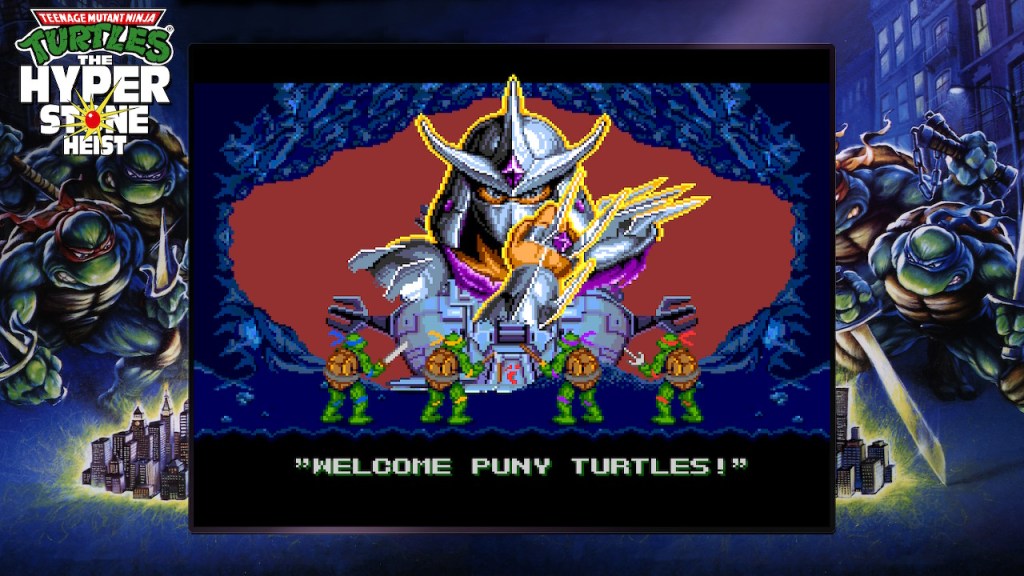
Even today, Teenage Mutant Ninja Turtles: The Hyperstone Heist still remains a worthy entry in this well-known franchise. I’d personally rank it the third best game, only falling behind Turtles in Time for the SNES and the rather recent Shredder’s Revenge. Whether you’re a fan of TMNT, beat-em ups, or both, Hyperstone Heist still serves as a perfect reflection of a time when the turtles and video games went hand in hand.

 Gaming Resurged
Leave a comment