
| PlayStation 5 | PlayStation 4 | Nintendo Switch | PC |
| Reviewed On: Nintendo Switch |
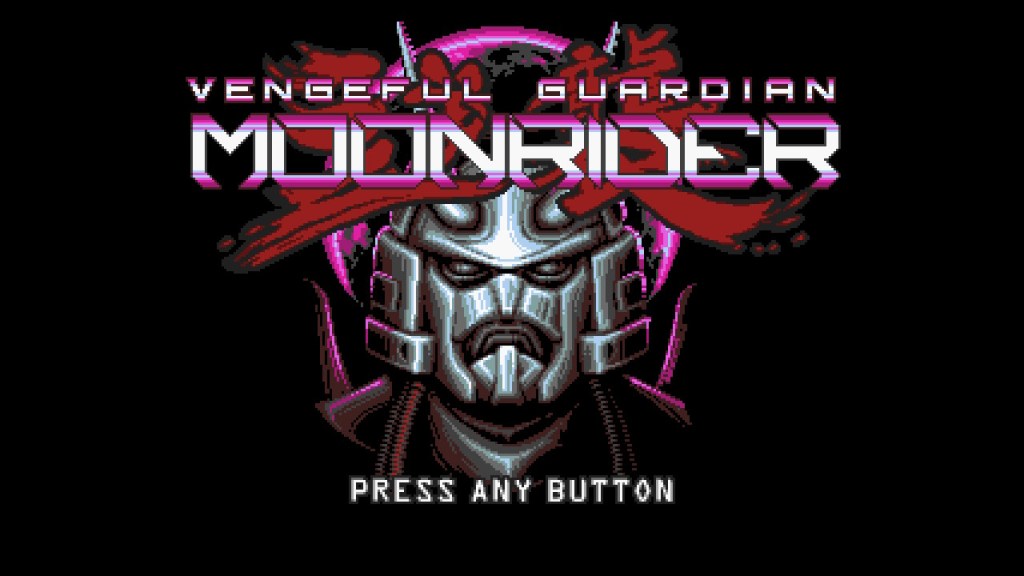
I hold Joymasher to very high standards after playing Blazing Chrome. The game perfected run-and-gun gameplay by combining elements from the classics. When the developer announced their latest action platformer: Vengeful Guardian: Moonrider, I had high hopes that’d it do the same. Drawing inspiration from titles like Shinobi, Mega Man, and Strider, the game aims to earn a spot amongst the influential action titles of the 16-bit era. While it falls short of this goal Vengeful Guardian: Moonrider is still a solid adventure worthy of at least one playthrough.
As far as presentation, Joymasher completely nails the aesthetic they’ve striven for. If released during the 90s, this game would be right at home on a Sega Genesis or Super Nintendo. 16-bit graphics have aged like fine wine and have stood the test of time. Musically the game seems to be inspired by sci-fi and samurai films, combining synthwave with traditional Japanese instruments. The graphics along with the soundtrack add to the immersion of the game’s world.
The character design immediately caught my attention and was a key factor in influencing my purchase. Seemingly taking influence from anime and Japanese superheroes, Moonrider bears an uncanny resemblance to the protagonist of the 1995 film Mechanical Violator Hakaider. He also borrows elements from Japanese history. In addition to robotics, his armor carries the likeness of a samurai, making him look like a cross between a cyborg and a shogun.

The adventure begins with Moonrider’s awakening. He and eight other guardians were created to protect a totalitarian government from any potential uprisings. During his installation, Moonrider rejects his programming and viciously kills his creators. With a newfound ambition to liberate the people, Moonrider sets out to disable the other guardians and weaken the government’s grip on society.
It’s an interesting plot, one that carries a subtle message about free will and questioning the ethics of old systems and traditions. However, it lacks expansion, with details only being found in brief cut scenes and banter between Moonrider and the other guardians. I feel that the overall narrative could’ve benefited from a little more context. It’s clear that each character has their own reasons for favoring freedom or order, but these reasons are merely glossed over.
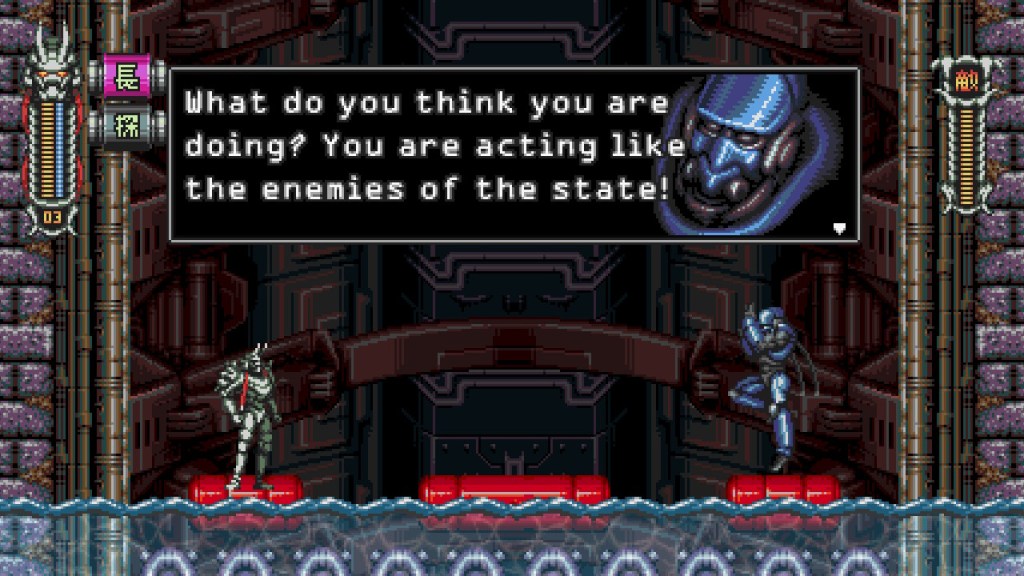
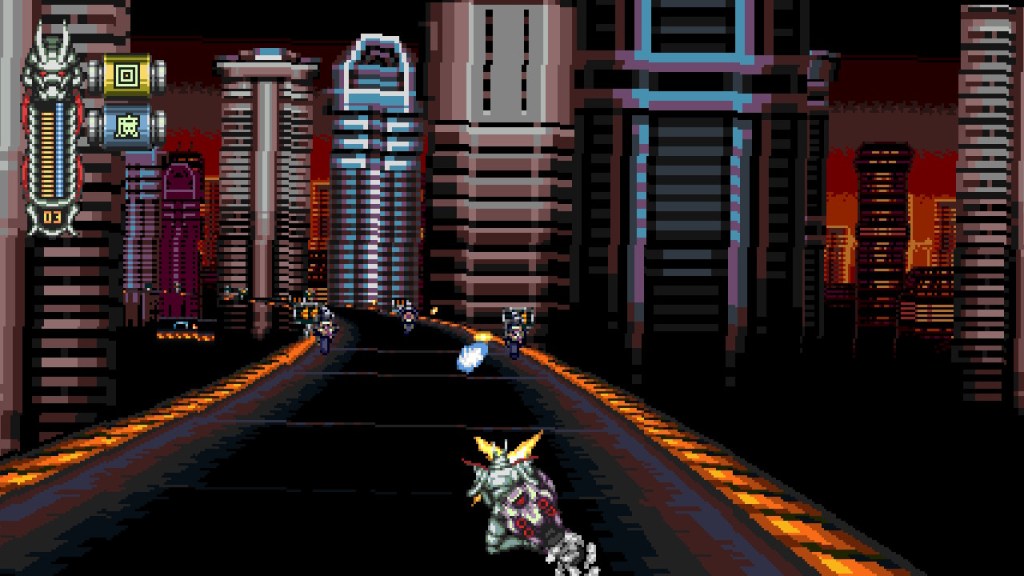
It’s easy to see why the story takes a back seat. The developers sacrificed narrative in favor of action. Tight and responsive controls allow for precise combat and platforming. Moonrider can sprint, wall jump, slice baddies, and even engage in vehicular combat via motorcycle. Overall, he controls like a dream and I wish I could give similar praise to the more complex mechanics of the game.
Along with his base arsenal, Moonrider can enhance his abilities by obtaining special weapons from bosses or locating capsules hidden throughout stages. Both of these mechanics are a nod to Mega Man X, except here they’re not executed nearly as well. The special weapon concept lacks the rock-paper-scissors element of its inspiration. Since the bosses hold no weaknesses to certain abilities, the special moves end up unbalanced. An example of this is the darkportal weapon, a tentacle that has an absurd range, can deal multiple hits, and makes the other moves feel obsolete in comparison.
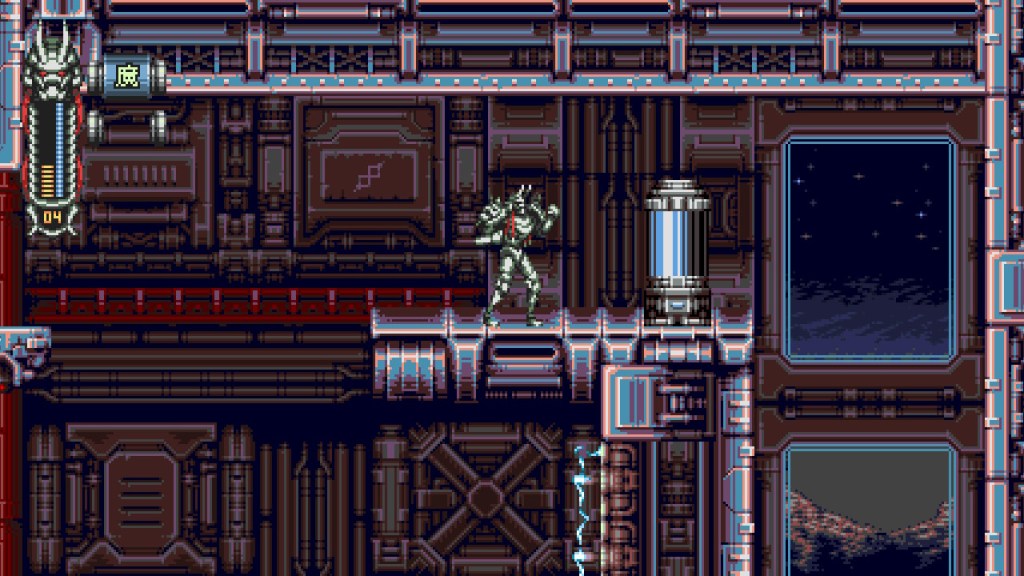
The capsules were something that could’ve added more replayability to the game. In Mega Man X, they provided an incentive to thoroughly search each level, but it feels like Vengeful Guardian: Moonrider intended the opposite. One of the first capsules I found gave Moonrider a power module allowing him to easily locate the other capsules and this is a testament to how easy most of these upgrades make the game. Some modules made enemies drop health when slain or gave Moonrider the ability to regenerate his special meter. Even with an equip limit of only two modules, the game is far too gracious with energy and health drops for it to be a handicap.
Not all the modules are overpowered but the ones that aren’t raise another issue. Not all of the upgrades should be tied to power modules. Examples of this are the acrobat, chameleon, and glass cannon modules. The acrobat ability allows Moonrider to double jump, a staple of most action platformers that’s either unlocked from the beginning or a passive ability when acquired. The chameleon module lets players change the color of Moonrider, something that’s purely cosmetic and not beneficial from a gameplay standpoint.
Glass cannon is arguably the most confusing. This module causes Moonrider to die from a single hit. This should’ve been a standalone game mode. Even stranger, equipping it has no impact on the game’s ranking system. Depending on how fast players clear the stage, they’ll receive a grade with “S” being the best. Making an S-rank achievable only when having the glass cannon module equipped would’ve been perfect for players looking for more of a challenge.
Vengeful Guardian: Moonrider is an action platformer with near-perfect controls, great art direction, and an excellent soundtrack. However, the special weapons and power modules make the game far too forgiving. The lack of unlockable characters and additional game modes, stifles its replayability, making it a step back from Blazing Chrome. Still, there’s a lot of untapped potential here regarding the game’s characters and world. With a sequel, JoyMasher can create a better experience, one with a better replay factor that also further explores the complex ideologies within the universe they’ve created.


 Gaming Resurged
Leave a comment